|
|
I've often
used a boom arm to hold a light over a model -- more often
than not, it's a little further back and used as a hair
light, to provide a little tonal separation with the backdrop.
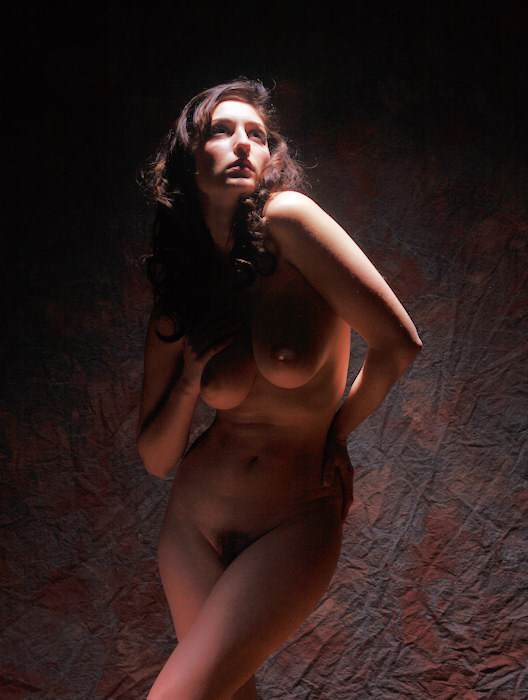
On occasion, however, I use a overhead downlight as a main
light.
For the
most part, I had a boom arm that could be placed on top
of my most sturdy lightstand. With a counterbalance,
you can reach out & place the light above the model.
But at full extension, the whole contraption wasn't overly
secure, even when counterbalanced. With the counterbalance
weight, the whole boom arm was heavy, and it was difficult
moving it to full height. Once there, the whole stand
was now top heavy & easy to tip over. Further,
it took up a lot of critical floor space. As a result,
I didn't use it as much as I would like.
I finally
got tired of the whole bother. I got a boom arm that
attached to a strategic spot on the wall. I got just
four little screw heads sticking out of the wall, and when
I want to use the boom arm, I just mount it to the screw
heads with some washers & thumb screws. It's strong &
solid, and it doesn't have to be counterbalanced.
It doesn't take up any floor space.
So I
was anxious to try the new boom arm out.
|
|
|
|
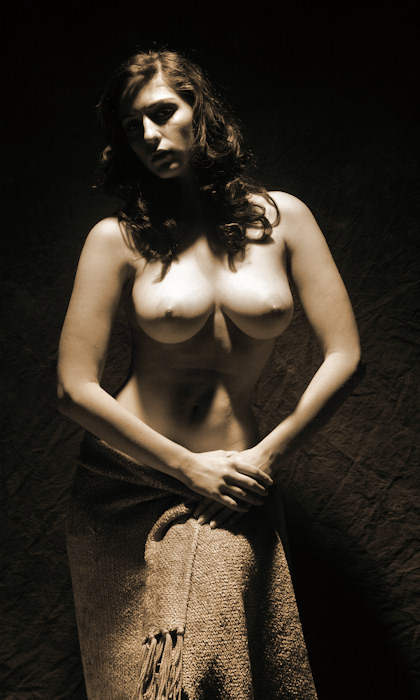
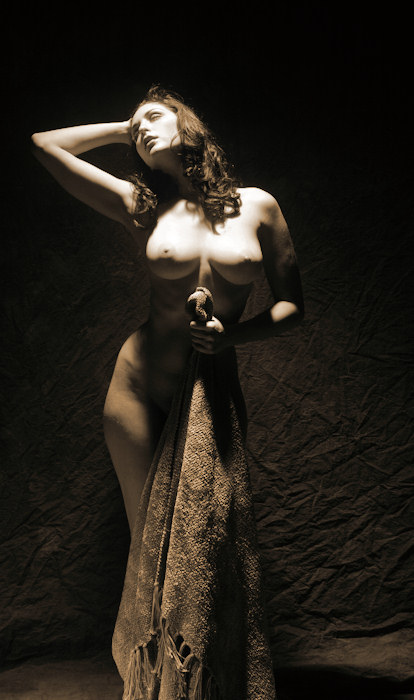
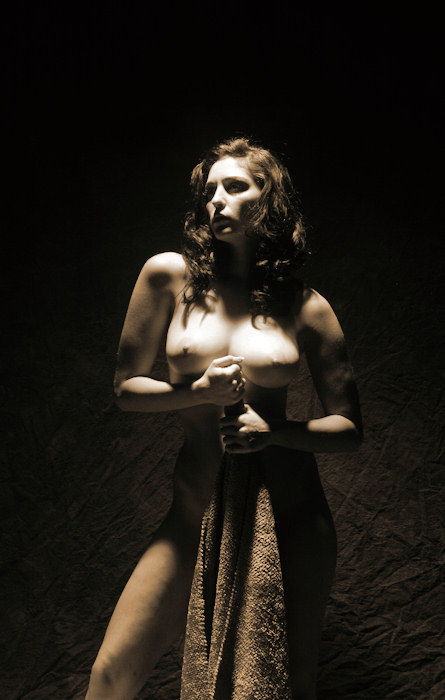
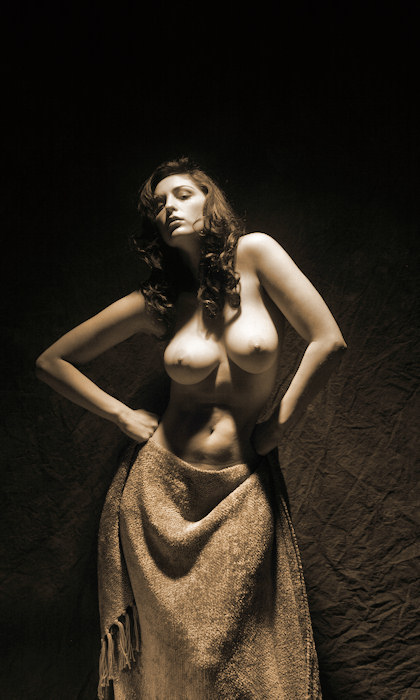
I especially
wanted to try this concept out with someone with a curvy
figure, like Carlotta.
But,
in retrospect, I'm not a big fan of these images.
Sure, some are interesting, but I figure that if you are
in a studio situation, using only one single light is amateurish.
Sure, this might appear to be dramatic, but I think my tastes
have grown to be more sophisticated over the years.
But despite
all that, we do make some interesting examples of the genre.
|
|
Here's a
token color image -- there's not much advantage to providing
the color, is there?
Carlotta's
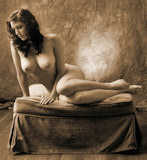
pose is an interesting shape, and I like to ghostly uplighting
from the main light bouncing off the shiny wooden floor.
|
|
|
|
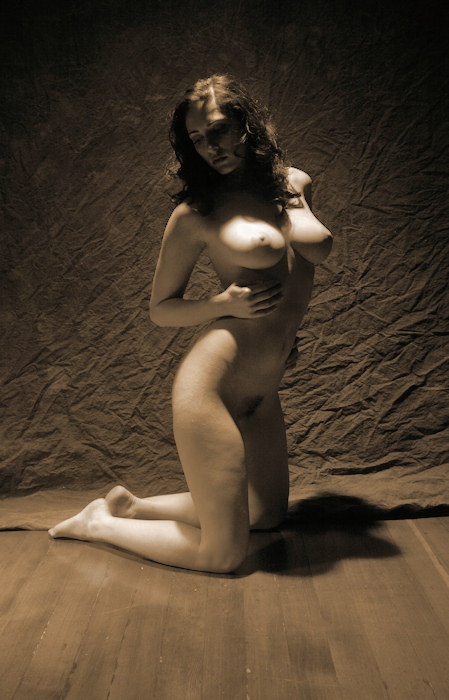
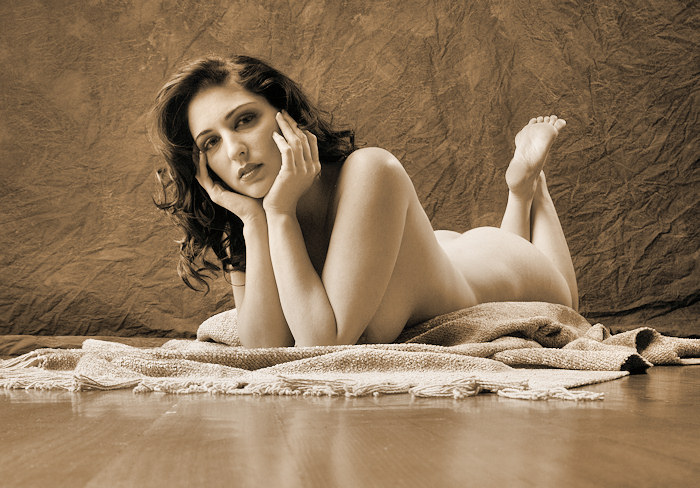
We try some
floor images with the downlight.
Around
this time, I lose momentum, and Carlotta comments that she's
not comfortable with the lighting. I can see her point:
harsh downlight will highlight any flaw in the figure, no
matter how small. That, coupled with my feeling that
single harsh light source images lack the kind of sophistication
I want, makes me agree to abandon this lighting setup immediately.
Y'know
-- a different model would have kept silent. After
all, I was paying her, and I was the one expected to make
all the aesthetic decisions. But I'm very glad that
Carlotta spoke up. I figure that if a model isn't
comfortable with a setup, it'll show, no matter how well
she can hide it. Besides, I like to think that I typically
have 150% more ideas than time, and if one particular idea
isn't working, it's no big deal to drop it & try something
else.
|
|
|
|
Since we
got Carlotta one the floor already, we left her there.
I scramble around to put together more conventional lights,
and we start trying to find a vision.
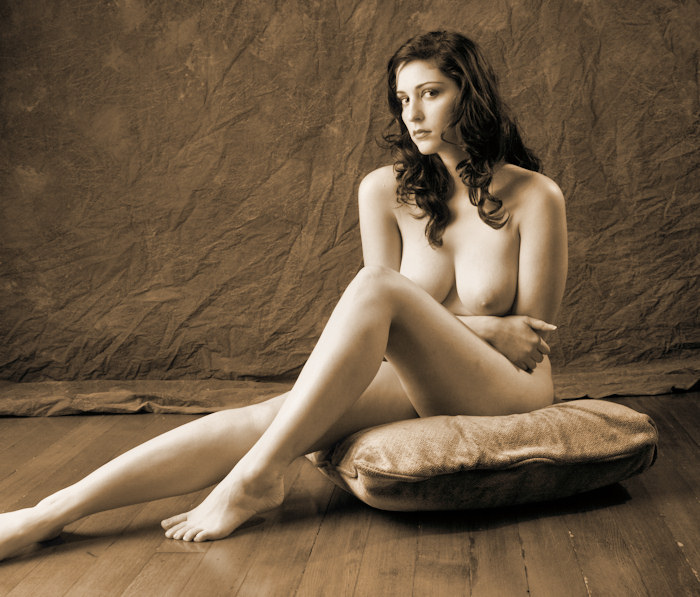
I look
at a lot of nude images, and I've had dozens of nude models
over here in my house. Something that baffles me.
These models don't have a stitch of clothing on, yet sometimes
they appear to be more nude than at other times. I
couldn't tell you why that it. Here's an example.
Carlotta is bareassed naked, but all her naughty bits are
covered. Yet she appears more nude to me than many
of the more-revealing other images we made. Compare
it to the image directly below. Go figure.
|
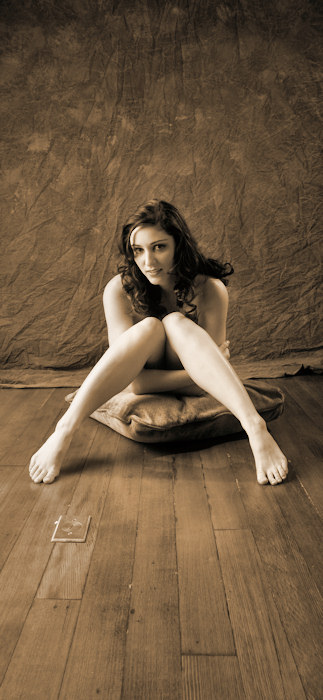
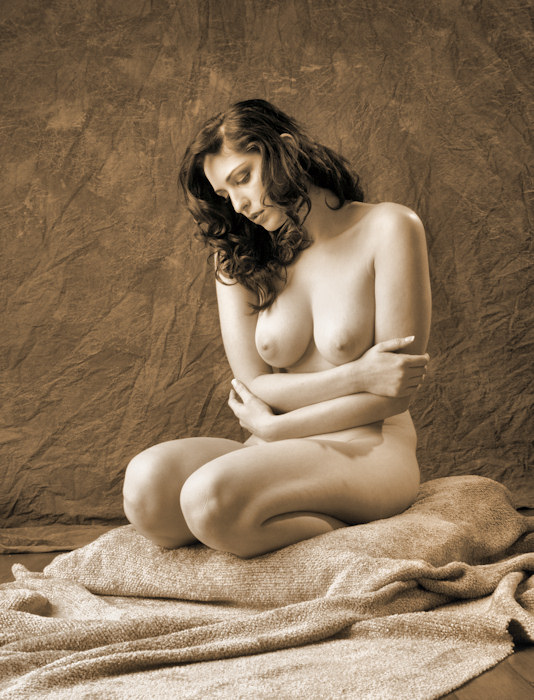
I like this
image a lot. I like...
-
... the unusual proportions (tall & narrow),
-
... the unusual composition,
-
... the unusual pose / body shape,
-
... the real expression on Carlotta's face.
I get
the sense that she was looking at, and reacting to, me in
this picture, as opposed to looking at the camera.
That's what I like most of all.
|
|
|
|
|
Something
I should have mentioned earlier. In order to help
out Carlotta and my local fellow photographers, I set it
up so that other photographers could sign up for time with
Carlotta working here at my house. That way, photographers
who could not afford a two hour session could sign up for
a single hour, and Carlotta wouldn't have to worry about
the logistics & the commute time. I signed up
for a ~2.5 hour session (my typical duration), but there
was a beginner photographer who worked with Carlotta for
an hour before my time started. He arrived early to
set up, and since he was more of a beginner, we consulted
on the best ways to execute his ideas. I kinda think
that this setup worked well for Carlotta -- she got a full
half day's work without commuting to three different locations.
It worked well for the beginner photographer, who get a
chance to work with a very experienced model at an affordable
rate. But I've got to admit that by the time I got
towards the end of my time with Carlotta, I was getting
pretty tired. |
|
|
|
When I'm
tired, my ideas don't flow as freely as usual, and my self-critical
filter becomes more forgiving. But being analytical &
cerebral, I am prepared for these moments. I have
a list of ideas of things I eventually want to try.
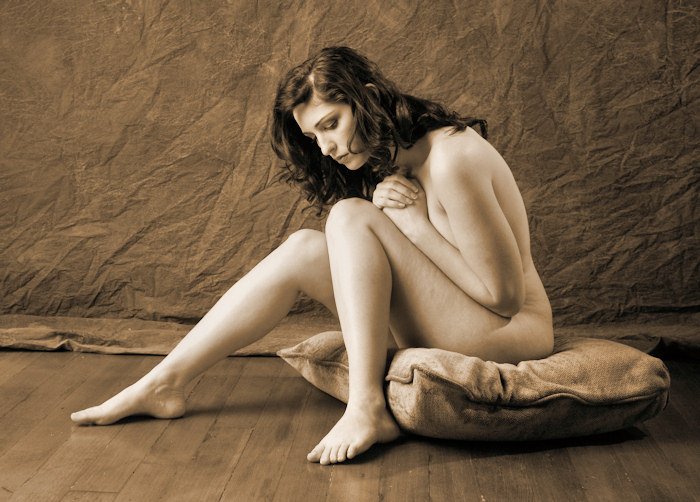
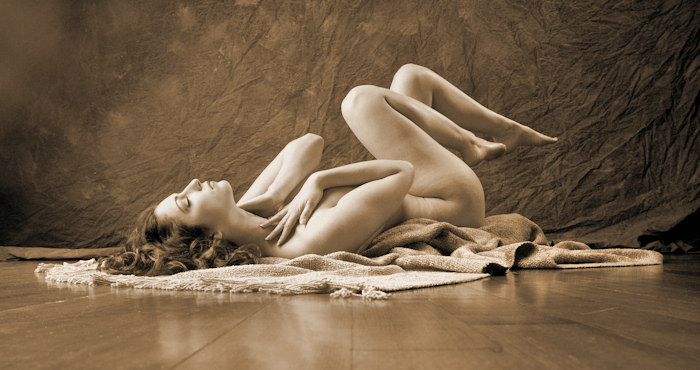
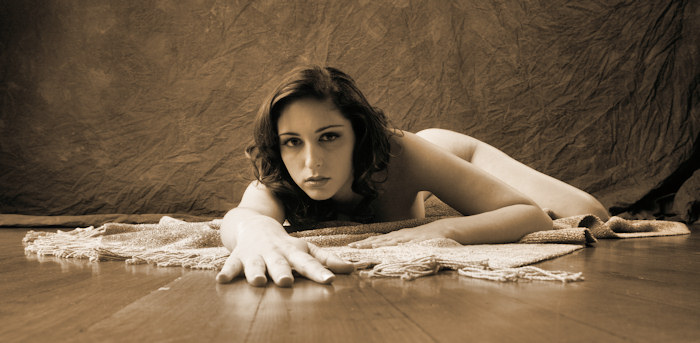
One such idea: I don't photograph horizontal models
enough. So, perhaps because I was getting tired, we
try some. |
|
|
I guess
I don't photograph horizontal models often because such
images appear uncomfortable for the model and are definitely
uncomfortable for me. So, we sit up.
|
|
"Up, down, left, right, near, far"
The
first time Carlotta
came over, she worked with Jessica here, and I got to
watch. One thing that Jessica did was that she moved
in close, very close, to Carlotta, and Carlotta was quite
comfortable with that. Carlotta continued to move &
pose despite Jessica being just inches away.
When
I'm working during a session, there's this little litany
going on in my head; it goes "up, down, left, right,
near, far". Its purpose is to remind me to look
at my model from different angles, to move around the model,
and to consider all perspective variations before moving
away from a particular setup.
I'm looking
to break my habits (both good & bad habits), and I suspect
that I maintain a comfortable difference from the model.
So, for more than a few images, I decide to risk cooties
and move in close to Carlotta. We produce some sweet &
lovely pictures this way.
|
|
|
|
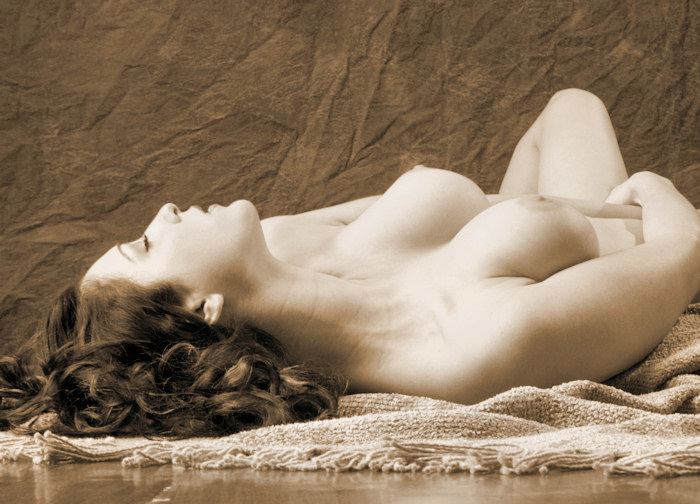
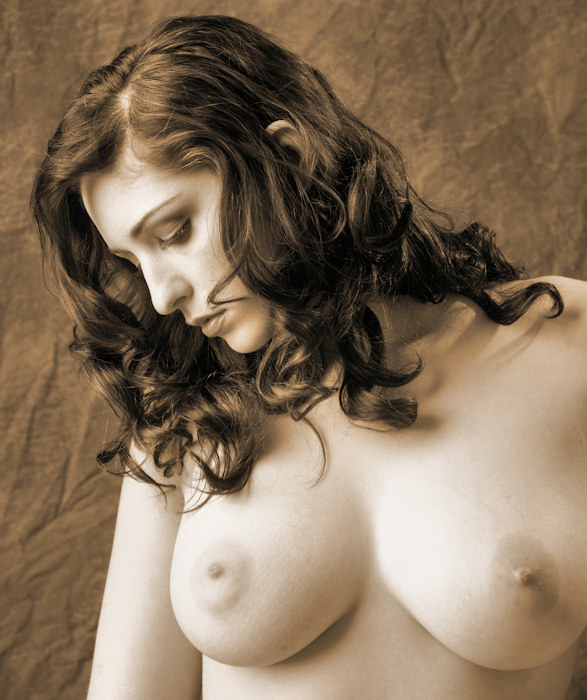
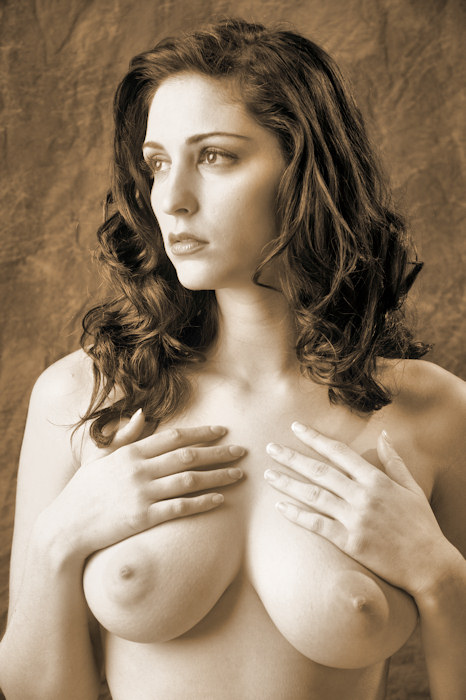
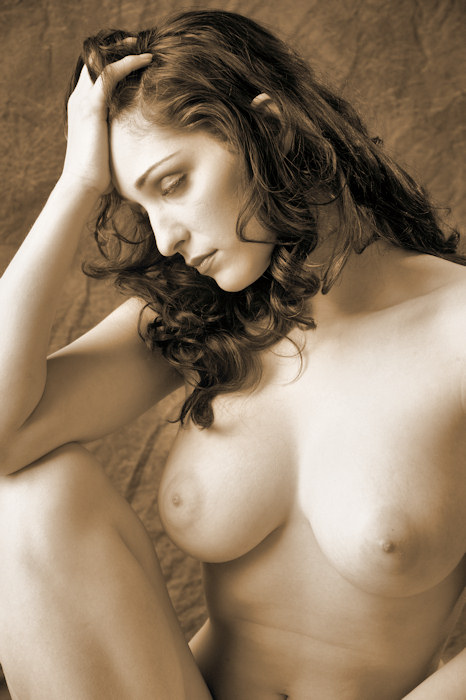
The image above
is one of those "model staring off into the distance"
pictures; I don't care for pictures like that. It
shows a disconnect between the model & the photographer.
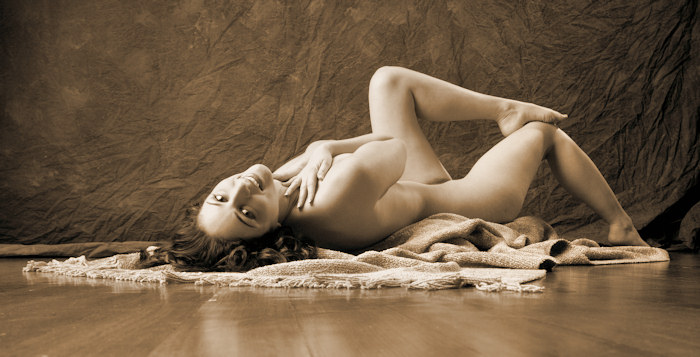
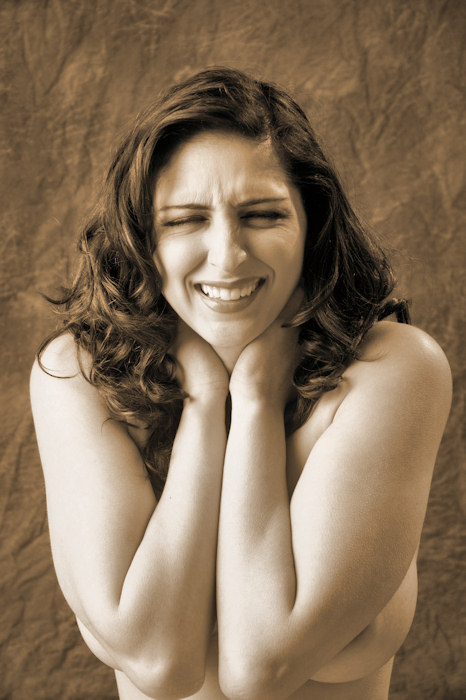
This
image to the left: it's not one of my best images
-- in fact, it's far from it. But it's more typical
of what goes on in a photo sitting with me. I don't
remember what I said, but I did crack Carlotta up with some
weird & quirky comment. That's an accomplishment
-- I'm proud of that.
|
|
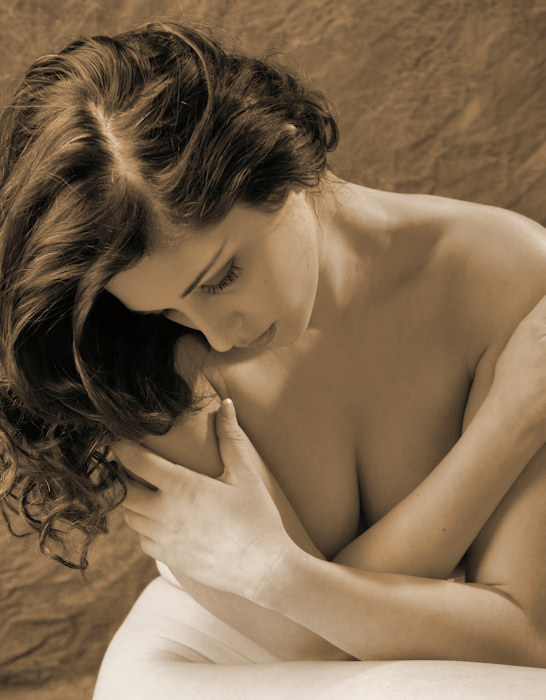
I'm a fan
of one-shoulder-higher-than-the-other images, but in this
one, it seems a tad forced. |
|
|
|
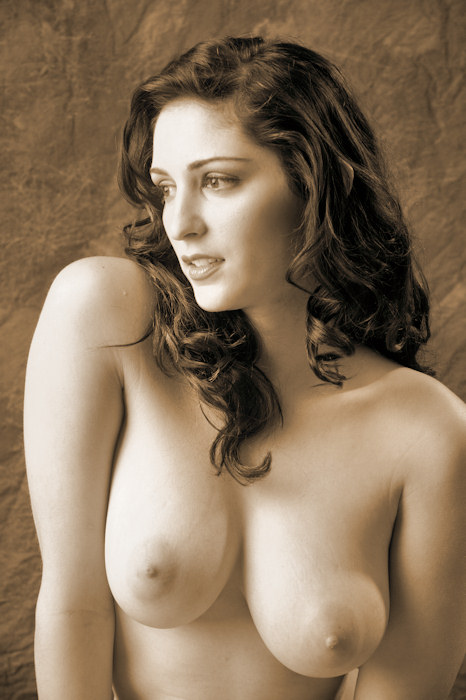
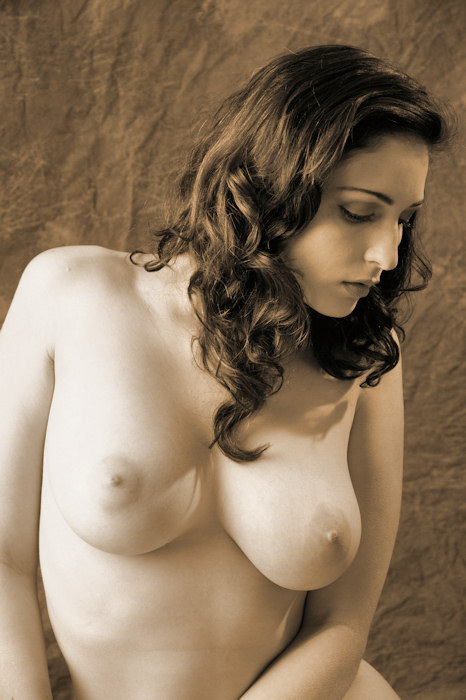
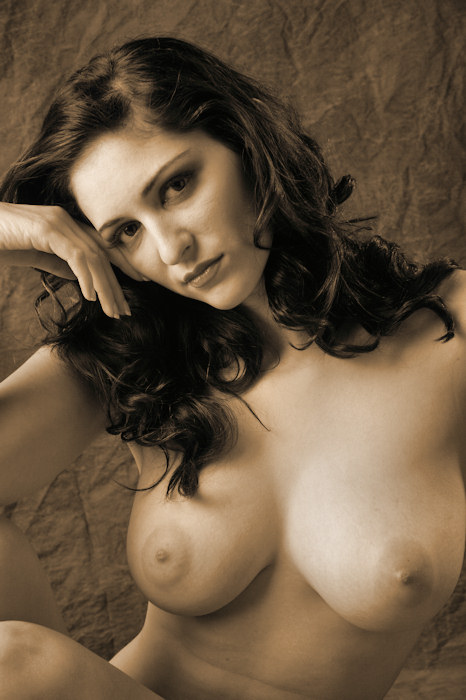
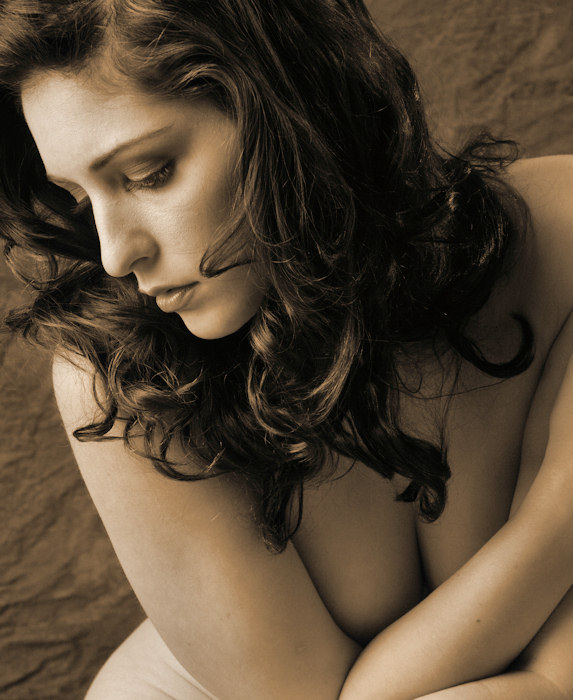
Now that
I look at these pictures as a group, these closer up pictures
have less eye contact than when I keep my distance.
It might have been better moving in "close" via
a mild telephoto lens, as opposed to moving in physically
close. Something to think about.
|
|